Runes, Scripts & Symbol Systems · The Living Archive
Viking-Age Runestones: Names, Memory and the Younger Futhark
My High Priestess ·
- Tradition:
- Runic writing
- Context:
- Scandinavia
- Period:
- Viking Age and later reception
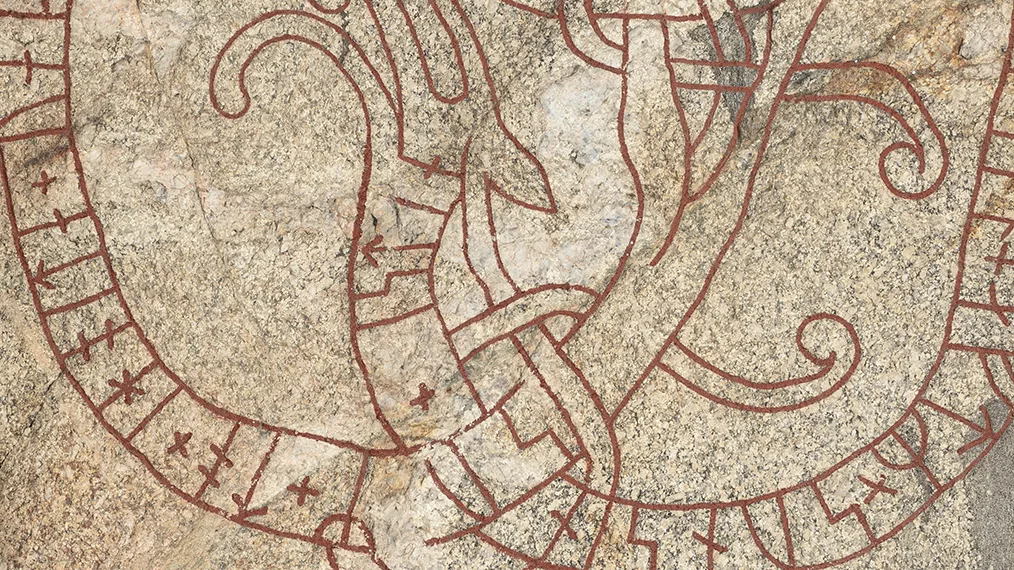
Unna wanted her son's name to remain in the world. Sometime between 1050 and 1080, she commissioned a stone for Östen. The inscription remembered his death and asked God to help his soul. A cross formed part of the monument.
That might surprise someone whose first encounter with runes was a bag of divination stones. Yet Unna's memorial brings us directly into the world of historical runic writing: families, grief, faith, skilled craftsmanship and the public work of remembering.
Runestones can be spectacular objects. They are also statements made by particular people. Learning to notice who raised a stone, whom it commemorates, and what its words claim gives us a much fuller understanding of what runes did.
First, an alphabet with a history
Runes are writing signs, not a language of their own. The University of Oslo's Historical Museum explains this in its account of the origin and development of runes. Early runic writing used a 24-sign alphabet, conventionally called the Elder Futhark. Futhark takes its name from its first six signs, much as alphabet names its first two Greek letters.
The museum describes changes around the eighth century that produced a shorter Scandinavian system, the Younger Futhark. It also notes that runic writing developed differently in England, where additional signs were used, and that Scandinavia retained runic writing especially long.
This means “runes” covers several related writing systems across time and place. A chart of 24 Elder Futhark signs is not automatically a key to every Viking-Age inscription. The date, region and alphabet all affect what a reader is looking at.
The letters' angular appearance is distinctive, but a sign's shape alone cannot tell us the purpose of the object carrying it. A mark on a comb, a memorial inscription and a modern divination piece require different contexts.
What a runestone was doing in the landscape
The Swedish History Museum's introduction to runes describes the 16-sign alphabet common in the Viking Age and the concentration of surviving stones in Sweden, especially Uppland. It also places runic writing on materials including wood, horn and everyday objects.
Large memorials were a particular use of writing. Their commissioners needed resources and access to skilled labor. A stone could make a family name visible to people beyond the immediate household.
The National Museum of Denmark's account of Viking-Age rune stones emphasizes their placement near routes and bridges, their painted surfaces, and the fact that a memorial need not stand over its subject's grave. They were intended to be encountered.
Think about what that changes. The stone speaks to travelers and neighbors as well as descendants. The person named may have died elsewhere. The monument can bring an absent person into a local landscape and connect that person with the family who paid for the commemoration.
A memorial's message also reflects choices. It cannot tell an entire life. It preserves what someone wanted future viewers to know, in a medium meant to last.
Unna, Östen and a prayer in stone
The Swedish History Museum identifies Unna's stone as U 613, from Torsätra in Uppland. Its account dates the monument through its ornament, particularly the style of the serpent's head. The inscription describes Östen as dying in white garments, understood in connection with baptism, and ends with a prayer for his soul.
The carving is attributed to Visäte through comparison with other work, rather than a signature on this stone. This is an important distinction: an attribution can be well supported without being a name explicitly supplied by the inscription.
Unna's memorial makes Christianity part of runic history. The script did not belong exclusively to one religious identity. Here a mother used it to make a Christian request on behalf of her son.
The emotional scale is equally important. We can discuss alphabets and stylistic dating, but the inscription also records a relationship. Someone was someone's child. Someone arranged and financed the words through which that child would be remembered. The object makes a historical person visible without giving us permission to invent the rest of her life.
Ragnhild and the people who commissioned memory
Women also appear as commissioners in Denmark. The National Museum's rune-stone overview describes the Glavendrup monument on Funen, raised by Ragnhild and her sons for Alli. The account identifies Alli through his religious and social standing and names Sóti as the carver.
Those roles help us read a memorial as a collaboration. There is the person remembered, the people commissioning the work, and the craftsperson who turns the request into an object. The person who “speaks” through a stone is therefore not always the person whose hand made the letters.
Read beside Unna's memorial, Glavendrup also shows how religion and kinship could be expressed through a shared writing tradition in different circumstances. The texts do not require us to squeeze every commissioner into one uniform picture of Viking belief.
The repeated appearance of women as patrons gives them a place in public remembrance. That does not by itself establish that all women held equal power. It tells us something more concrete: these named women could participate in commissioning lasting monuments and presenting family relationships to others.
Jelling: a family monument becomes a royal statement
At Jelling in Denmark, the scale broadens. UNESCO's description of the Jelling mounds, runic stones and church places the tenth-century monuments at a major transition between older religious traditions and Christianity.
The larger stone is associated with Harald Bluetooth. In the National Museum of Denmark's account of the Jelling stone, Harald commemorates his parents, Gorm and Thyra, while asserting royal achievement and the Christianization of the Danes.
Family memory and political authority occupy the same monument. A king identifies his parents and tells an audience what his rule has accomplished. An inscription of this kind is an act of public self-presentation, so its claims should be understood as claims made by royal authority.
It also helps explain why a script cannot be assigned one simple spiritual label. The same writing tradition could serve remembrance, devotion and state formation. The image, words, site and patron all contribute to its meaning.
Jelling invites us to widen our view beyond a single line of text. The stones belong to a landscape of mounds and a church. The setting makes the transition in religious and political life physically present.
Can a carver's hand bring a queen into focus?
In 2023, Lisbeth Imer, Laila Kitzler Åhfeldt and Henrik Zedig published research comparing runestone carving through 3D scanning. Their published abstract links the Jelling 2 and Læborg stones through the hand of Ravnunge-Tue, combining technical study with language and spelling.
The argument also concerns Thyra. Her name occurs on the Jelling stones and other regional monuments. If those references identify the same woman, her commemorative presence would be exceptional in Viking-Age Denmark. The researchers interpret the evidence as supporting a pivotal role for her in the emergence of the Danish state.
The conditional matters: identifying the same name on several objects does not automatically settle identity. Yet the possibility is compelling. A close examination of cut marks can contribute to a larger account of leadership and memory.
Here the carver is more than an anonymous technician. Habits of making letters can help connect commissions, places and patrons. The physical act of writing becomes historical evidence alongside the message written.
Stones had later lives, too
The Swedish History Museum's record for runestone 44653_HST describes a fragmentary red sandstone monument dated by its appearance to the ninth or tenth century. Its surviving text mentions a brother, Gerulv, and ancestral mothers. The museum interprets those maternal references as evidence for the significance of female as well as male lineage.
The record also traces reuse: the fragment was probably part of a coffin slab at Ärja Church, later served as a step at Kärnbo Church, and was moved again. A stone's survival may depend on uses its commissioner never imagined.
That history changes how we picture the archaeological record. What survives is not a neatly preserved original landscape. Objects break, move and acquire new purposes. A fragment may retain an intimate statement while losing the words that once explained its setting.
The missing text is part of the encounter. We can value the surviving names and relationships without filling the gaps with a story that the object cannot support.
Reading a runestone today
The Swedish National Heritage Board's Runor platform brings together inscriptions, images and reports, with searches by text and location. It provides a way to explore writing in relation to actual objects and places.
Three terms help when browsing. An inscription is the text on the object. A transliteration represents its runic signs using another alphabet. A translation renders an interpretation of the language into a language you read. Those stages are related, but they are not interchangeable. Damaged signs or uncertain word divisions can affect more than one stage.
Modern rune divination belongs to another part of the subject's history. A contemporary reader may assign meanings to individual signs and draw or cast them. A medieval or Viking-Age memorial text has a different job: its signs form words and names within an inscription. Historical writing deserves to be understood before it is turned into a set of isolated symbols.
The runestones reward that attention. They introduce us to patrons, craftspeople, parents, children and rulers who wanted something remembered. Their durability can make them feel distant from ordinary life. Their words repeatedly bring us back to it.
Sources and further reading
- University of Oslo, Historical Museum, “The Origin and Development of Runes”.
- Swedish History Museum, “Runes” and “Unna's Stone,” U 613.
- National Museum of Denmark, “Rune Stones” and “The Jelling Stone”.
- UNESCO World Heritage Centre, “Jelling Mounds, Runic Stones and Church”.
- Lisbeth Imer, Laila Kitzler Åhfeldt and Henrik Zedig, “A Lady of Leadership,” Antiquity 97 (2023), 1262–78. Published abstract and bibliographic record.
- Swedish History Museum, runestone 44653_HST collection record.
- Swedish National Heritage Board, “About Runor”.
Key terms
- Transliteration (Runic writing)
- A transliteration represents its runic signs using another alphabet.
Related reading
Conversation
Loading comments…