Tarot & Cartomancy · The Living Archive
Before the Reading: How Tarot Became Tarot
My High Priestess ·
- Tradition:
- Tarot
- Context:
- Northern Italy, Europe and modern international readerships
- Period:
- Fifteenth century to the present
Someone painted the first surviving tarot cards for people who could afford extraordinary things. Gold catches the light behind a figure's head. A sleeve announces wealth. A ruler occupies a small rectangle of painted space, ready to be held in a player's hand.
It is a wonderfully human beginning for something now asked to speak about love, grief, purpose and change. Tarot's history includes workshops, games, trade, occult speculation and artists whose decisions still shape the cards people buy today. Following those threads helps us see what is actually in the deck.
Northern Italy, a game and a world of images
The earliest documented tarot references appear in northern Italy in the middle of the fifteenth century. Tim Husband's Metropolitan Museum essay on early tarot places the cards within the courts and cities of Renaissance Italy, including Milan, Venice and Florence. Tarot developed as a game involving trump cards, within a wider culture of playing cards.
A familiar structure eventually combined four suits with a sequence of trumps and a Fool. Each suit had ten numbered cards and four court figures: king, queen, knight and knave. The resulting 78-card arrangement is recognizable to many readers today, although the terminology and interpretation have changed.
The distinction between a game and a reading helps us understand the images. A triumph over another card is a rule within play. It does not automatically give that card the spiritual meaning found in a modern guidebook. Likewise, the presence of religious or moral imagery does not establish that the original deck was designed for fortune-telling.
The cards emerged from a world where religion, hierarchy, allegory and entertainment already shared visual space. Those images could become available for new interpretations precisely because they were rich enough to hold them.
The surviving decks tell a less tidy story
The early material does not fit perfectly into the standard box sold today. Yale Library dates its Visconti di Modrone cards to about 1440–45. Its account of the Team Tarocchi conservation project describes female knights and pages as well as cards representing Faith, Hope and Charity. Sixty-seven cards survive from a deck researchers believe originally contained at least 89.
That matters. The earliest luxury decks demonstrate experimentation and variation, rather than one complete, fixed system handed down without alteration. Their attribution is also a research question: Yale's account discusses newer scholarship proposing Andrea Bembo for its cards, where related decks have often been associated with Bonifacio Bembo and his workshop.
Conservators and scientists study layers, materials and workmanship alongside historians studying imagery and patronage. These objects have biographies of their own. A replacement card, a lost group or an altered attribution changes what we can responsibly say about the whole.
For a reader, the reward is freedom from the idea that every meaningful feature must be original to the earliest deck. Tarot has been made and remade by people. That creative history is part of its substance.
From painted luxuries to printed families
Printing helped cards circulate beyond individual painted commissions. One important family is now called Tarot de Marseille. The Folger Shakespeare Library's “Fortune's Fools” describes related French designs from the mid-seventeenth through the eighteenth centuries, produced from printing blocks and colored by hand.
Marseille is a family name in this context, rather than a guarantee that every deck was made in that city. Folger's comparisons include makers working in Paris, Lyon and Avignon. Small differences in figures, lettering and arrangement help identify relationships among editions.
The numbered suit cards in such decks generally display repeated suit emblems. A Ten of Swords can present ten swords arranged across the card, without a scene of human drama. This is an important difference from many later illustrated decks. Reading a pip arrangement invites attention to number, pattern and the relationships among emblems; a narrative scene adds characters, gestures and a setting.
Neither visual form is inherently more spiritual. They give the eye different things to work with. Understanding that difference prevents a beginner from wondering why one guidebook's detailed scene is missing from another perfectly legitimate tarot deck.
How Egypt entered the story
By the late eighteenth century, writers were giving tarot new occult histories and uses. The V&A's history of tarot cards describes the period's claims of Egyptian origins and the work of Etteilla, born Jean-Baptiste Alliette, who brought tarot into his cartomantic practice after working with ordinary playing cards.
The Egyptian-origin story has been enormously influential. Its influence is historically real; the claimed origin is unproven. These are separate statements. An interpretation can change the future of a practice even when its account of the practice's past is mistaken.
A specific surviving object makes the change visible. Wellcome Collection holds Etteilla's tableau of tarot as leaves of the Book of Thoth, catalogued as a Paris work of the 1780s. It combines engravings, watercolor, letterpress and gouache, arranging the cards according to a supposed Egyptian setting.
The tableau is evidence for what an eighteenth-century occultist imagined and presented. Its Egyptian setting is part of that presentation. When we look at it, we are watching someone build a new framework around existing images: organizing them, naming their authority and teaching an audience how to regard them.
A deck can carry several systems at once
Later occult interpretation connected tarot with correspondences drawn from numerology, astrology and esoteric readings of Kabbalah. The V&A describes this nineteenth-century expansion. Such correspondences became important to particular schools, but they are not all visible in the same form in a fifteenth-century painted card.
For beginners, a correspondence is an asserted relationship between elements of different systems. A card might be linked to a planet, an element, a letter or a number. That link gains its meaning within the school using it. If two guidebooks disagree, the disagreement may come from different frameworks rather than an error in counting.
It is worth letting the systems remain identifiable. A later occult use of Hebrew letters, for example, does not make every tarot reading an expression of Jewish religious practice. A card's modern astrological association also does not mean its earliest painter was encoding that association. The dates of the relationships matter.
Pamela Colman Smith changes what people can see
In 1909, Pamela Colman Smith illustrated the deck associated with Arthur Edward Waite and the publisher Rider. The Whitney Museum's discussion of Smith and her cards places her work alongside her background in theater, design and storytelling, including her experience growing up in Jamaica.
The addition of narrative scenes to numbered suit cards made a lasting difference to how many people encountered tarot. Instead of beginning only with a suit and a number, a reader could begin with an event: someone waiting, defending a position, sharing something or walking away.
Smith's broader artistic life deserves room in the story. The National Trust's account of her work at Smallhythe Place describes her friendship with Ellen Terry and Edith Craig and drawings associated with the Lyceum Company's 1900 tour. Those records help restore an artist to the center of a history too often told only through the male author's name.
Her contribution also helps explain why a tiny change in an image can transform a reading. A turned face, an offered hand or a figure standing outside a group gives the reader relationships to consider. Illustration participates in the meaning. It is not simply a decorative wrapper around it.
One wand, several possible beginnings
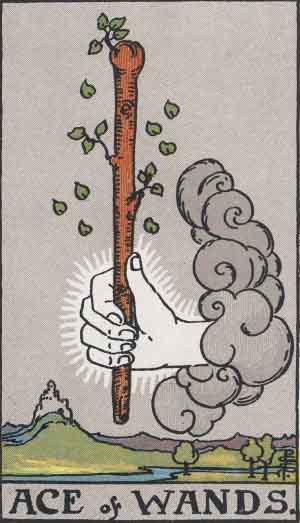
Waite's description of the Ace of Wands in The Pictorial Key to the Tarot describes a hand emerging from a cloud and holding a wand. His divinatory vocabulary includes creation, enterprise and beginnings. This is a specific early-twentieth-century interpretation of a specific image.
Consider how its language could enter different questions. In a conversation about work, enterprise might bring a proposed project into focus. In a conversation about art, creation might draw attention to the beginning of a piece. In a conversation about capacity, the same image might raise a question about whether enthusiasm has a place to go.
These are illustrative possibilities, not predictions. They show why a reading requires more than attaching one permanent sentence to a card. The subject of the question changes what an image can reasonably contribute.
A neighboring card or an assigned spread position adds another relationship. “What is beginning?” asks something different from “What is preventing a beginning?” A reader who explains those steps gives us a way to understand the interpretation instead of simply receiving a verdict.
The deck in your hands has an ancestry
Today, tarot remains available both for play and for a wide range of interpretive practices. Folger's account notes the continuing life of tarot games in continental Europe. Contemporary artists also reinterpret the visual vocabulary, sometimes following Smith's scenes closely and sometimes building an entirely different world.
Before opening a guidebook, look at the deck itself. Does it use narrative scenes on the numbered cards? Are the suits familiar? Has the maker changed titles, figures or the order of the trumps? Those choices will shape the conversation you can have with it.
Tarot's history gives us a way to enjoy all of that with greater attention. The painted court card, the printed pip arrangement, the occult tableau and the illustrated scene each brought something into the deck's life. A reading today takes place in the company of those choices. Knowing who made them lets us appreciate the images more fully and interpret them with more care.
Sources and further reading
- Tim Husband, “Before Fortune-Telling: The History and Structure of Tarot Cards,” Metropolitan Museum of Art, 2016.
- Yale Library, “In the Cards: Library Partners Work Together to Solve Mysteries of Rare Tarot Deck”, October 4, 2023.
- Folger Shakespeare Library, “Fortune's Fools: Early Tarot Cards”.
- Rebecca Billingham, Ruth Hibbard and Josephine Nardecchia, “A History of Tarot Cards,” V&A.
- Wellcome Collection, Etteilla's Book of Thoth tableau, reference 584577i, catalogued 1780–89? Public Domain Mark.
- Whitney Museum of American Art, discussion of Pamela Colman Smith's tarot illustrations, 2022.
- National Trust, “Pamela Coleman Smith at Smallhythe Place”.
- Arthur Edward Waite, “Ace of Wands,” The Pictorial Key to the Tarot. Primary historical interpretation.
Key terms
- Correspondence (Tarot)
- For beginners, a correspondence is an asserted relationship between elements of different systems.
Objects & further exploration
Our Boutique offers My High Priestess’s own tarot decks and books. Reading never requires a purchase.
Visit the BoutiqueRelated reading
Conversation
Loading comments…