
Numerology & Number Symbolism
Gematria: When Letters Become Numbers
Follow Hebrew letters into number, rabbinic interpretation and worked examples, with the different methods kept visible.
Hebrew gematria and Greek isopsephy · Antiquity to present
Collection
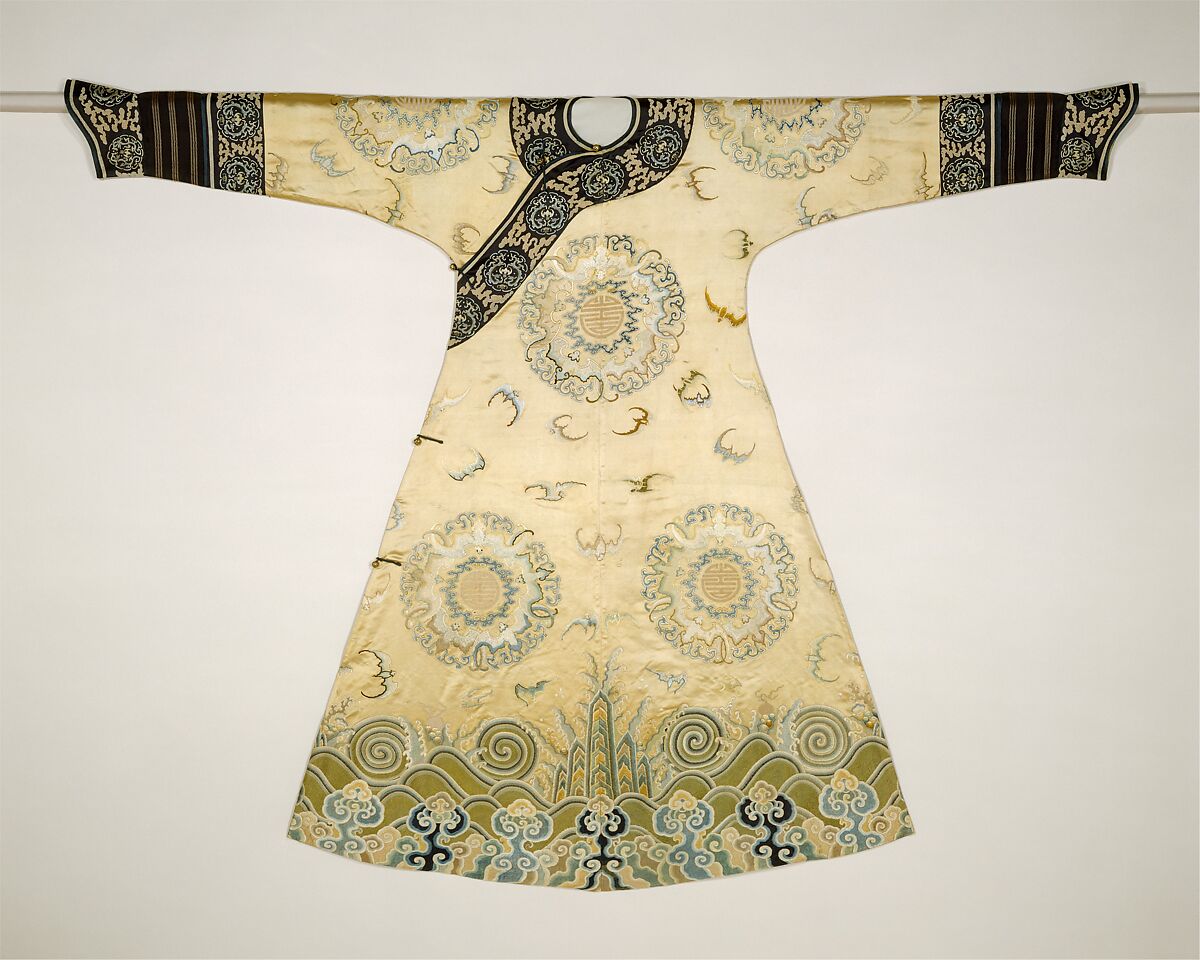
Five embroidered bats gather around a character for longevity on an eighteenth-century Chinese robe. A Hebrew word becomes a sum. A modern reader adds the digits of a birth date and interprets the result. Each involves numbers, but the numbers are doing different work.
That variety makes this subject worth exploring. Numbers can organize a calendar, express a philosophical account of order, connect passages of a sacred text or carry a wish for someone's well-being. In modern numerology they also become a vocabulary for discussing personality and the course of a life.
This collection follows those meanings into their particular histories. We will meet calculations as well as objects, people as well as symbols. A number becomes more interesting when we understand why it mattered in the first place.
Number symbolism assigns significance to a quantity or numerical pattern. A group of five objects might represent five blessings. The number's meaning belongs to a cultural setting, image or text.
Letter-number interpretation begins with an alphabet whose letters have assigned numerical values. A reader calculates a word's total and considers a relationship with another word or passage. Hebrew gematria and Greek isopsephy belong within this broad area, with distinct languages and histories.
Modern personal numerology commonly uses names and birth dates to produce interpreted numbers. Its methods include digit reduction, alphabet tables and rules about which compound numbers to retain.
The categories can overlap. They are useful because they keep the activity visible. Counting nine figures on a garment, interpreting a sacred word and calculating a Life Path are not interchangeable operations, even when the same numeral appears.
Pythagoras lived approximately 570–490 BCE, first on Samos and later at Croton in southern Italy. As Carl Huffman's Stanford Encyclopedia account explains, he left no writings, and later traditions greatly enlarged his reputation. His early importance included religious discipline and teachings about the soul, alongside an interest in significant numerical relationships.
The surviving record becomes more specific with later Pythagoreans. Philolaus of Croton, who lived approximately 470–385 BCE, described the world through limiters, unlimiteds and their fitting together, or harmonia. Musical relationships supplied an important example: an octave can be expressed through a ratio of 2:1, a fifth through 3:2 and a fourth through 4:3.
Here number helps explain a relationship that can be heard. A continuous range of possible sounds becomes an ordered scale. The philosophical question concerns how a world acquires intelligible structure.
That history helps explain why Pythagoras remains a powerful name in number traditions. It does not, on its own, document every modern alphabet chart or birthday calculation under his authorship. To understand a present-day method, we still need to look at the actual rule being used and the history of its transmission.
In Hebrew notation, letters can represent numerical values. Gematria uses those values interpretively, particularly in Jewish textual traditions. The Jewish Encyclopedia's historical account discusses its place among methods of interpretation and examples in rabbinic literature.
A small example shows the operation. The Hebrew word ḥai, associated with life or being alive, is written חי. In standard letter values, ḥet is 8 and yod is 10, giving a total of 18. The connection depends on the Hebrew spelling. Writing the English letters C-H-A-I and applying another table would be a different calculation.
The result becomes meaningful through interpretation and use. Eighteen does not contain an independently readable English definition of life. A reader recognizes a relationship between a word, a writing system and an established set of numerical values.
Greek isopsephy similarly involves the numerical values of Greek letters. The presence of related techniques in different languages creates a valuable comparison, while spelling and alphabet remain essential to the result. Our feature Gematria: When Letters Become Numbers explores Hebrew examples, alternative methods and a Greek-scriptural context in more detail.
The Metropolitan Museum of Art's Woman's ceremonial robe, object 43.119, dates to the first half of the eighteenth century during China's Qing dynasty. Its decoration gives number symbolism a material setting.
The museum explains a wordplay: the Chinese word for bat sounds like the word for happiness. Five interlocking bats around the character shou, longevity, evoke five happinesses: longevity, health, wealth, virtue and a natural death.
The number belongs to a whole composition. The creatures, their grouping, the written character, the language and the garment work together. Someone encountering only the numeral five would miss most of the message.
This kind of symbolism carries affection and social meaning. A wish for a flourishing life can be embroidered, worn and recognized. Numbers participate in an exchange among people, rather than functioning only as private descriptions of an individual's character.
It also explains why a universal list of lucky-number meanings can be disappointing. The historical object gives us more: a particular visual arrangement, a linguistic connection and a recognizable set of wishes.
By the early twentieth century, English-language readers could encounter number interpretation in books devoted to personal and spiritual development. The Library of Congress catalogues L. Dow Balliett's The Philosophy of Numbers; Their Tone and Colors as published in Atlantic City in 1908.
The publication record supplies a concrete person, title, place and date. It is evidence of a modern printed number tradition, rather than evidence that an entire contemporary method existed unchanged in antiquity. Its pairing of numbers, tones and colors also reveals an interest in correspondences among different kinds of experience.
Today, books, readers and digital calculators circulate methods commonly described as Pythagorean, Chaldean or other systems. The label alone is not enough to reconstruct their rules. Two services can use similar language while assigning different values, reducing at different stages or treating compound numbers differently.
That is why the method belongs beside the meaning. A personal result should be reproducible from the information and rules supplied, even when its interpretation remains spiritual or symbolic.
Digit reduction adds the digits of a number and repeats the addition until a chosen stopping point is reached. For example, 28 becomes 2 + 8 = 10, then 1 + 0 = 1. That arithmetic is straightforward. The interpretive system determines what to do with the result.
For a hypothetical date of May 14, 1992, a component-reduction approach gives month 5, day 1 + 4 = 5, and year 1 + 9 + 9 + 2 = 21, then 2 + 1 = 3. Adding those components gives 13, which reduces to 4. This is an illustrative calculation, not a result assigned to an actual visitor.
Numerology.com's Life Path explanation provides one contemporary practitioner's rule: reduce the month, day and year separately while retaining designated master numbers, then combine the results. Its account retains 11, 22 and 33 under specified circumstances. Other readers may use different conventions, so a description should name the one being followed.
A name calculation adds further choices. Which spelling is used? Which alphabet? Are diacritics preserved, transliterated or removed? Does the method use a birth name, a chosen name or both? These choices affect the input before interpretation even begins.
Another modern printed example is Cheiro's Book of Numbers, chapter XII, printed pages 70–71 in the digitized Herbert Jenkins edition. Cheiro calls his letter table Chaldean and Hebrew. That is his attribution of its origin, rather than independent documentation of an ancient Babylonian alphabet chart.
His table assigns letters values from 1 through 8, leaving no individual letter at 9. A name's total can nevertheless reduce to 9, and the book interprets that result. He also distinguishes compound totals from their reduced single digits.
This explains why two name readings can disagree without an addition error. The value table, treatment of compound numbers and choice of the commonly used name are all part of Cheiro's method. The calculation carries the author's rules with it.
| What you encounter | What helps make sense of it |
|---|---|
| A Life Path result | The full date, calendar, reduction sequence and master-number rule |
| A name number | The exact spelling, alphabet and value table |
| A gematria total | The original word, language and named calculation method |
| A number in an artwork | The object's culture, date, imagery and setting |
| A repeated number noticed in daily life | The contemporary belief being used and the personal circumstances of the observation |
Return to the hypothetical Life Path 4 above. Numerology.com's account of the number 4 associates it with practical effort, reliability, service and the creation of stability. It also describes a potential difficulty with rigidity. A reading built from that account might explore how dependable habits support a person, and when familiar methods become difficult to change.
The tension gives the interpretation somewhere to go. Being reliable does not require doing everything alone. Enjoying structure does not remove the capacity to improvise. The number supplies a set of themes to consider in relation to a real life, rather than a complete inventory of what someone can become.
The arithmetic can be correct without establishing every interpretation attached to it. This gives readers room to examine a symbolic account thoughtfully. A description may provide a productive question about independence, cooperation or responsibility without becoming a verdict about someone's limits.
Across this collection, the aim is to make the relationship visible: between number and word, ratio and sound, image and wish, calculation and personal meaning. Following those relationships leads us into histories that are richer than a list of keywords.
Numerology & Number Symbolism
Follow Hebrew letters into number, rabbinic interpretation and worked examples, with the different methods kept visible.
Hebrew gematria and Greek isopsephy · Antiquity to present