
Past Lives, Rebirth & Reincarnation · The Living Archive
Buddhist Rebirth: Continuity, Karma and the Question of the Self
My High Priestess ·
- Tradition:
- Buddhist traditions
- Context:
- Pāli, Thai and Tibetan Buddhist contexts
- Period:
- Early discourses to present
In a Buddhist discourse, a monk named Sāti insists that the same consciousness travels from life to life. The Buddha challenges him. Consciousness, the discourse explains, arises in dependence on conditions.
That exchange opens one of the most interesting questions in the study of rebirth. If a permanent, unchanging self is not what carries a life forward, how can there be continuity? What connects an action with a consequence, or one birth with another?
Buddhist traditions have developed sophisticated answers through philosophy, ethical teaching, narrative and ritual. This introduction follows several public texts and historical objects. It does not identify a reader's former life, and it does not assume that every Buddhist community uses the same account of what happens between lives.
A teaching concerned with release
The historical Buddha taught in northern India, broadly in the fifth century BCE. Mark Siderits's Stanford Encyclopedia article places his teachings within a search for liberation from suffering and explains the importance of non-self, karma and rebirth to the philosophical tradition that developed from them.
Saṃsāra is commonly used for the continuing cycle of birth and death. Nirvāṇa, or nibbāna in Pāli, concerns liberation from the conditions that sustain suffering. These terms give rebirth a purpose within Buddhist teaching. The subject is connected with understanding and transforming the processes through which suffering continues.
That emphasis can differ from a modern fascination with recovering a glamorous former identity. The questions include how craving operates, what actions cultivate, and how freedom becomes possible. A life matters in the present because choices participate in conditions with consequences.
The texts through which we encounter these teachings are religious transmissions preserved and interpreted by communities. They are primary sources for Buddhist thought, rather than contemporary recordings of conversations with the historical Buddha.
What the Sāti episode is asking us to notice
The Mahātaṇhāsaṅkhaya Sutta, Majjhima Nikāya 38, translated by Ṭhānissaro Bhikkhu, presents Sāti's position and the response to it. The discussion classifies consciousness according to its conditions: seeing depends on the eye and visible forms, hearing on the ear and sounds, and so on.
A fire provides an analogy. A fire is named according to what it burns, such as wood or grass. The teaching directs attention to the conditions through which an event arises, rather than treating consciousness as one independent thing that remains unchanged through every circumstance.
The difference is subtle but consequential. Experience is familiar enough that we can speak of “my consciousness.” The discourse asks what that experience depends upon. Its continuity does not automatically establish an unchanging owner beneath it.
For a beginner, the episode is useful because it shows a debate within the tradition's own texts. Rebirth was not simply a word added to an otherwise uncomplicated idea of a soul. The nature of continuity was itself a problem to be examined.
Non-self and the five aggregates
The Anattalakkhaṇa Sutta, Saṃyutta Nikāya 22.59, examines five aggregates: form, feeling, perception, mental formations and consciousness. Each is considered changeable and not fully subject to a person's command.
An aggregate is a grouping of processes or features through which experience is analyzed. Form concerns the material aspect; feeling concerns the tone of experience; perception involves recognition; formations include activities shaping experience; consciousness concerns awareness of an object. The translations and philosophical explanations of these terms vary, so an introductory English label cannot carry every nuance.
The text's questioning concerns whether what is unstable can appropriately be grasped as a permanent self. Its purpose is connected with release from clinging, rather than merely winning an abstract argument about whether a person exists.
Ordinary language can still identify a person and hold someone accountable. The philosophical inquiry asks whether that person contains an independent, unchanging essence. Keeping those levels distinct helps explain how Buddhist accounts can discuss lives and actions while challenging a permanent self.
Dependent origination: a process with conditions
Saṃyutta Nikāya 12.2 sets out dependent origination, also translated as dependent co-arising. Its sequence connects ignorance, formations, consciousness, name-and-form, the senses, contact, feeling, craving, clinging, becoming, birth, and aging and death.
This is a framework for examining how processes arise through conditions. The text also presents a cessation sequence: when sustaining conditions cease, the processes depending on them cease. The possibility of release is built into the account.
Even a short section of the sequence is revealing. Feeling, craving and clinging are distinguished. An experience's pleasant or unpleasant tone is one thing; the demand that it continue or disappear is another; holding tightly to a particular response adds a further relationship.
That distinction makes the account more specific than the general claim that everything is connected. It asks which conditions are doing what work. Different Buddhist interpretations develop the sequence in different ways, but the text gives us an identifiable set of relationships to investigate.
Karma begins with intentional action
The Sanskrit karma and Pāli kamma are often reduced in casual speech to a cosmic system of rewards and punishments. In the Nibbedhika Sutta, Aṅguttara Nikāya 6.63, intention is central to the explanation of action. The discourse distinguishes action through body, speech and mind and discusses its results.
This places attention on what a person cultivates and does. Speaking with the intention to deceive and speaking with the intention to clarify may involve the same physical capacity, but they have different ethical qualities and consequences.
The example is ordinary on purpose. Karma belongs to conduct, rather than only to dramatic events supposedly inherited from an inaccessible past. Choices made now are part of the field in which a life unfolds.
That also helps explain why Buddhist accounts of rebirth can remain strongly ethical without requiring an unchanging soul. A causal relationship can link actions and consequences even when the processes involved are changing.
A lamp lights another lamp
The later Buddhist dialogue known as the Questions of King Milinda explores this problem through Nāgasena's conversations with a king. In Book III, chapter 5, in T. W. Rhys Davids's translation, a lamp lighting another lamp illustrates rebirth without a thing migrating between bodies. A verse learned from a teacher supplies another analogy.
The images make continuity thinkable without treating it as the movement of a permanent object. The second lamp depends on the first lighting event, but we do not need to picture a little substance called “the flame” traveling intact between them. A student can learn a verse without removing the teacher's knowledge.
An analogy explains a proposed relationship; it does not scientifically establish rebirth. Its historical importance lies in the kind of problem it addresses. Buddhist writers were asking how continuity could be described without collapsing into either permanent identity or complete disconnection.
The dialogue also uses the relationship between planted seeds and later fruit when discussing responsibility. Changed conditions do not make consequences unrelated to what preceded them.
Previous lives as moral narratives
Rebirth also enters Buddhist life through stories. Jātakas recount lives associated with the bodhisatta, the being developing toward Buddhahood. San San May's British Library introduction to Burmese illustrated Jātaka manuscripts shows how these narratives connect previous lives with generosity, courage, truthfulness and other virtues.
One illustrated story, the Suvaṇṇamiga Jātaka, concerns a golden stag caught in a hunter's snare. His mate offers her own life, and the hunter's response changes the outcome. The story draws attention to loyalty, compassion and the possibility of abandoning killing.
These narratives allow ethical relationships to be explored through kings, animals, families and communities. Their importance is not exhausted by asking for a list of historical identities. They teach through the choices made inside the story.
The manuscripts also reveal the work of artists and patrons. A past-life narrative becomes an image that can be viewed, discussed, remembered and retold. The history of rebirth includes those forms of teaching and devotion.
A nineteenth-century Thai image of generosity
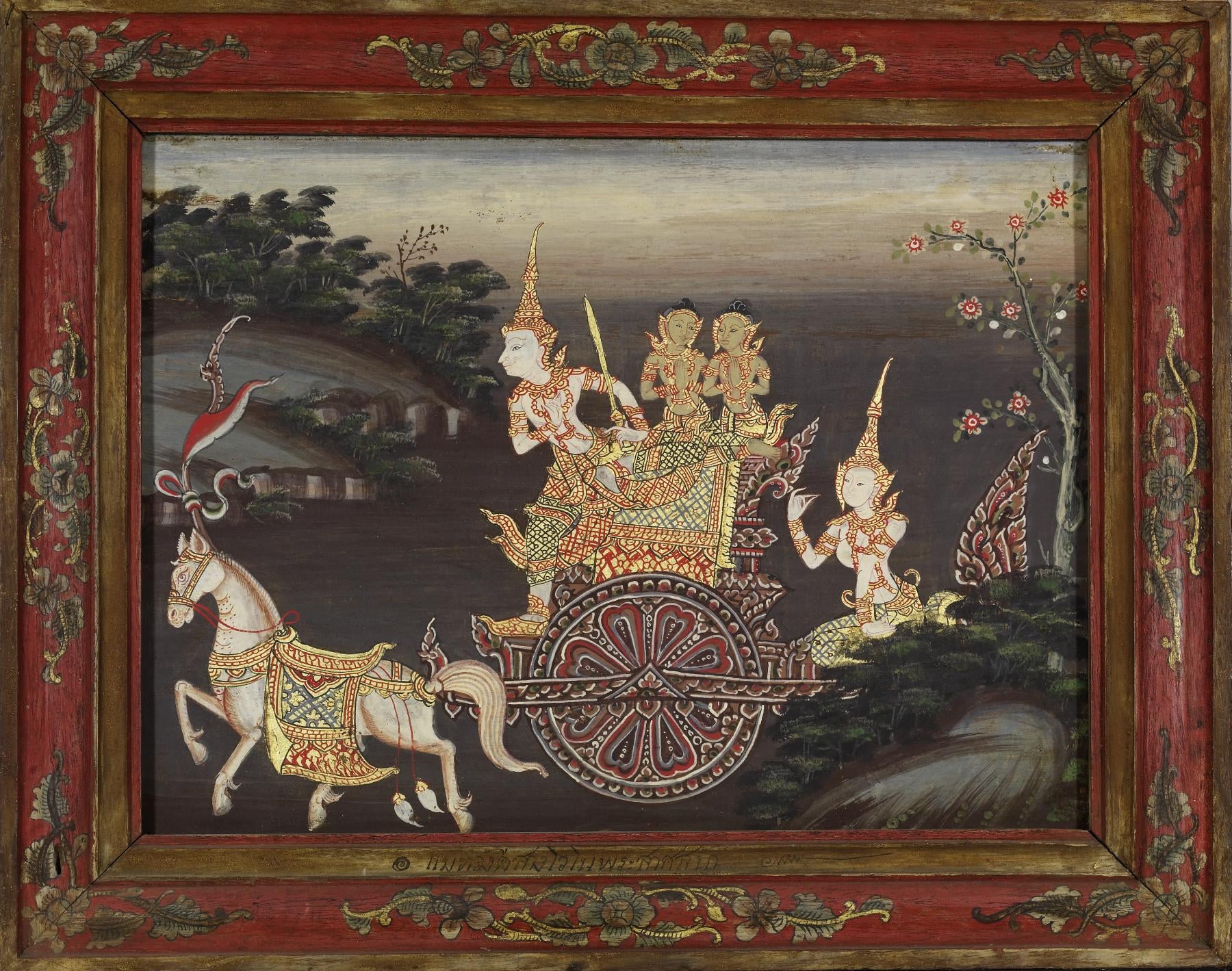
The Walters Art Museum holds a late-nineteenth-century Thai painting of Vessantara giving away his chariot. The scene belongs to the Vessantara Jātaka, associated with the perfection of generosity. The museum identifies the medium as glue tempera on teak and records an inscription naming Mother Thong as its commissioner for the religion.
The object gives the subject a specific place and period. A story associated with the Buddha's previous lives was being made visible through Thai artistic conventions and a named patron's religious gift.
Its material details matter. Wood, pigment, an inscription and a donor connect a large doctrinal idea with something someone chose to make and support. A narrative's continuing life depends partly on those acts of care and transmission.
Rebirth and Tibetan recognition traditions
Tibetan Buddhism developed institutions for recognizing some teachers as reincarnations of earlier masters. In his September 24, 2011 statement on rebirth and recognition, the Fourteenth Dalai Lama distinguishes ordinary rebirth under conditioning from rebirth attributed to compassion and prayer. These are explanations within his religious tradition.
The statement locates the formal recognition tradition in the early thirteenth century, with Karmapa Pakshi's recognition as the reincarnation of Düsum Khyenpa. It also discusses female as well as male recognition lineages, including Samding Dorje Phagmo.
This institutional history should remain identifiable as Tibetan. It is not the procedure through which every Buddhist community organizes teaching. Nor does a general interest in past lives authorize an outside writer to confer a recognized identity on someone.
The distinction shows the range of the subject: a philosophical account of continuity, an ethical narrative and a recognition institution can all concern rebirth while doing different work.
The present remains part of the picture
The Sīvaka Sutta, Saṃyutta Nikāya 36.21, rejects the claim that everything a person experiences is caused solely by past actions. Its discussion includes other conditions for painful experience. The point is important for understanding the limits of an oversimplified karmic explanation.
A person's suffering is not an invitation to invent a former-life offense. The texts themselves offer more complex accounts of causation, action and the possibility of change.
Buddhist rebirth therefore opens questions larger than “Who was I?” What is being sustained? Which intentions are taking shape? How does attachment operate? What allows a different response? Across the texts and objects discussed here, continuity matters because transformation remains possible. The subject brings attention back to the life being lived, with its relationships, choices and capacity for care.
Sources and further reading
- Mark Siderits, “Buddha,” Stanford Encyclopedia of Philosophy, revised 2023.
- Ṭhānissaro Bhikkhu, translations: MN 38, SN 22.59, SN 12.2, AN 6.63, and SN 36.21, Access to Insight. Brief paraphrases of identified passages, not reproductions of the translations.
- T. W. Rhys Davids, trans., Questions of King Milinda, Book III, chapter 5.
- San San May, “The Jatakas: Birth Stories of the Bodhisatta,” British Library, March 13, 2015.
- Walters Art Museum, Vessantara Jātaka, chapter 3, accession 35.233, late nineteenth century, Thailand.
- Fourteenth Dalai Lama, “Rebirth, Recognition & Tradition,” September 24, 2011. A primary statement of Tibetan Buddhist belief and institutional history.
Key terms
- Jātaka (Buddhist traditions)
- Jātakas recount lives associated with the bodhisatta, the being developing toward Buddhahood.
- Karma (Buddhist traditions)
- In Buddhist traditions, karma (Pāli: kamma) concerns intentional action through body, speech and mind, considered in relation to its conditions and consequences.
Related reading
Conversation
Loading comments…